the pipeline, end to end
Four stages, each feeding the next.
brasslamp is a pipeline, and this page walks it end to end. Four stages — design, draft, finish, publish — all of it running on your machine against a model you provide. There are two doors in: start from an idea, or start from a manuscript you've already written.
Already have a draft?
Skip to Start from a manuscript — the studio can be built around a book it never wrote.
1 · design
Build the book before the book
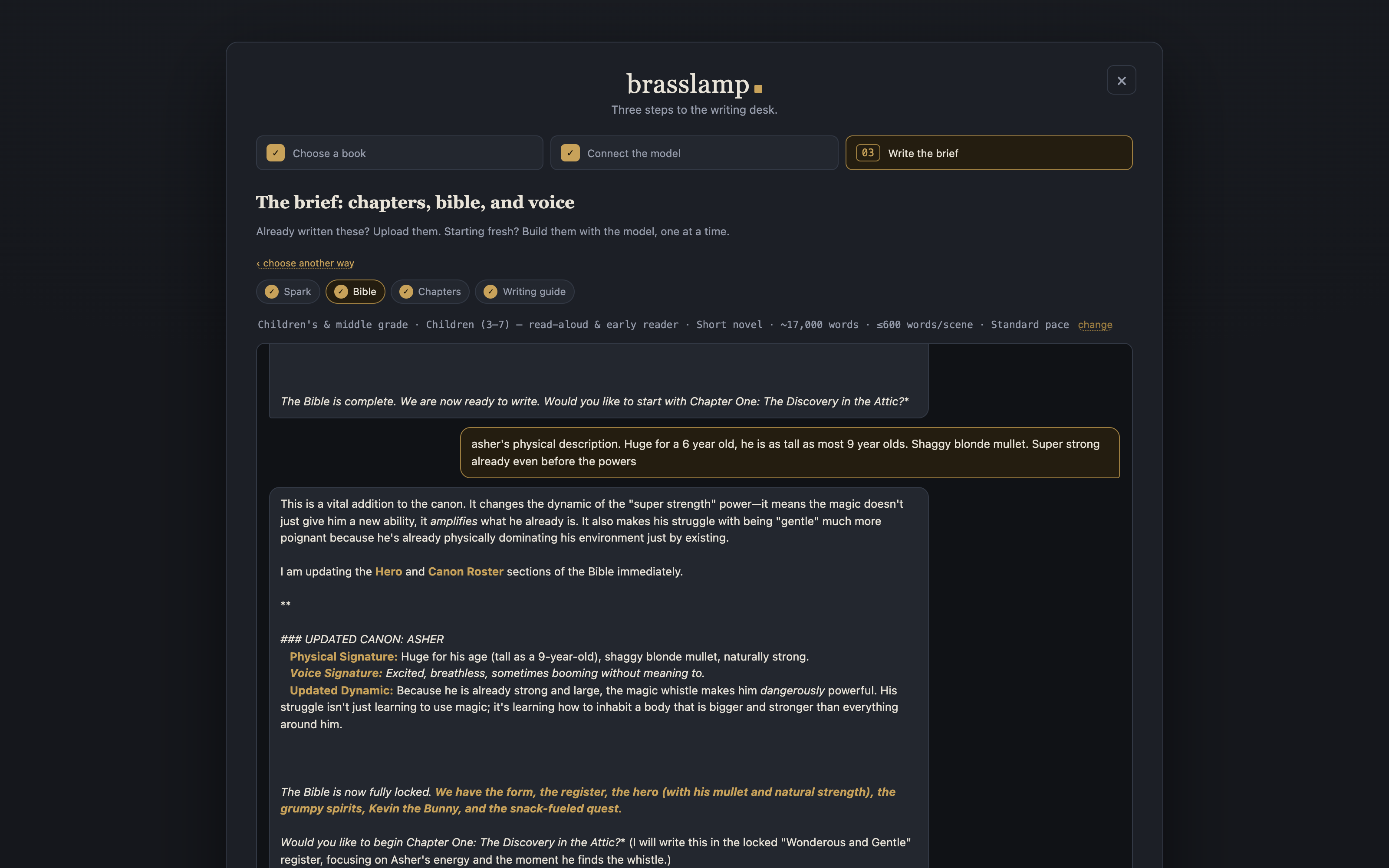
Every strong draft starts from three documents, and brasslamp interviews you to build them properly.
If the idea is still a spark, there's a room for that — an optional brainstorm where you riff on a seed, get contrasting directions, and carry the one you like into the build. It's explicitly skippable.
Then the architect takes over: a genre-aware interviewer — fantasy, sci-fi, mystery, romance, horror, LitRPG, general, or a custom category that fuses genres into one coherent profile — that pushes you through premise, characters, world, and chapter map, and refuses vague answers along the way. What comes out the other side:
The bible
Canon that actually works as canon: a roster of names, relationships, physical and voice signatures; the spellings of invented terms; world rules with costs; a chronology; a register spec; a voice sample; and a machine-checkable list of events the book must hit.
The outline
Chapter architecture with real math. Per-scene word budgets that sum to your target length, and a pace dial — brisk, standard, immersive — that changes the structure of scenes, not the padding inside them.
The writing guide
Ranked craft rules demonstrated with Wrong:/Right: example pairs and a closing voice sample, because examples steer a model better than adjectives do.
Before committing to a whole book, you can hear the voice: generate a short calibration passage in the locked style, react to it, revise the guide, and hear it again. And locking the plan runs an instant structural preflight — do the budgets sum? does every scene have a defined exit? did every bible section arrive? — so setup can't silently fail. A malformed outline is repaired automatically once before the tool asks you for help — and an under-planned one gets its arithmetic done for it: the tool computes how many scenes are missing at what length, asks for exactly those, and rejects the result unless every existing scene survives untouched.
2 · draft
Scene by scene, with a living memory
The engine writes the book one scene at a time, and it remembers.
A rolling story state follows the manuscript; a canon ledger keeps facts current, so when a character moves cities the new fact supersedes the stale one instead of piling up beside it; per-scene snapshots of the situation survive chapter breaks. Each scene is written knowing the next scene's brief and the shape of its chapter, so exits aim somewhere — and each chapter warm-starts from the previous chapter's closing prose, so the voice never resets at a boundary.
Quality is enforced, not requested. A built-in gate retries weak scenes with targeted feedback, and a deterministic detector bans the clichés that make AI prose smell like AI prose. Variety guards watch for repeated openings and recycled descriptions across chapters and steer away from them at write time. And for the moves that are fine once but deadly as a rhythm, an opt-in tell budget counts uses across the whole book — once a move's budget is spent, the gate rejects any new use. No per-scene check can see a book-wide count; this one can.
Two optional extras, both your choice: beat planning, which spends one extra model call per scene turning an outline line into a three-to-five beat plan before writing; and semantic retrieval, which uses a small local embeddings model to inject the most relevant earlier scenes before each new one.
And the run itself is patient. Interrupt anytime — close the laptop, kill the container — and generation resumes exactly where it left off, never duplicating a scene. Refresh the browser mid-run and it reattaches.

Write it together, if you'd rather
Co-author mode is a writing cadence, not a different product: the engine writes one scene (or one chapter — your call), runs every quality check it always runs, then stops and hands you the pen. Read it, rewrite anything, continue when ready. Your edits are the canon the next scene is built on — the continuity memory re-reads the page as you left it, not as the model wrote it. Flagged scenes are never auto-rerolled between sittings; you just read them, so you decide.
The second book in the background
The outline ends with offscreen tracks: a per-chapter timeline of what the antagonist, the factions, and the side characters are doing while your point-of-view character is elsewhere. Every scene is written knowing that state — under a hard rule that it's never narrated directly (a deterministic gate catches "Meanwhile, in the council chamber…" and other head-hops). Once per chapter the world ticks: planned beats occur, and offscreen actors react to what the page actually did. The bible's lived-in layer feeds the same goal — per-character voice samples, a named minor cast that recurs, geography with distances, textures and motifs that accumulate. Both retrofit onto existing books with one button each.
The whole studio, one picture
What feeds the writer, what the writer feeds back, and the loops that keep a book coherent. Hover or tap any box to trace just its connections.
Story bible
Canon, world rules, must-hit events — plus the lived-in layer: voice samples, a recurring minor cast, real geography.
Chapter outline
Every scene's job, end state, and declared place and time — ending with offscreen tracks: what everyone else is doing, chapter by chapter.
Writing guide
Voice, style, register — the spec the whole book is held to.
Retrofits
Deepen the bible or add offscreen tracks to an existing book — one click each, grounded in the book's own pages.
The standing world
Guide and craft rules, the bible, the rolling memory — and the meanwhile note: what's moving offscreen, never to be narrated, only encountered.
Recall
The most relevant earlier scenes are pulled back into view.
A beat plan
The scene gets a spine before a word is written — including what the character wants right now, and why.
Write
Scene by scene, never truncated mid-thought.
The gate
Deterministic checks — AI-prose tells, head-hops and cut-aways, cliché smells, echoed descriptions. Weak scenes retry with the specific reason.
The page
The scene lands; a snapshot of who's where, and what's unresolved, carries forward.
Your turn (optional)
Co-author mode pauses here. You edit; your version becomes the truth.
Memory
Synopsis and canon re-summarized from what was actually written.
The world ticks
Offscreen actors advance their plans — and react to what the hero just did.
A snapshot
The chapter's starting state is frozen, so any chapter can be regenerated later without disturbing its neighbors.
The passes
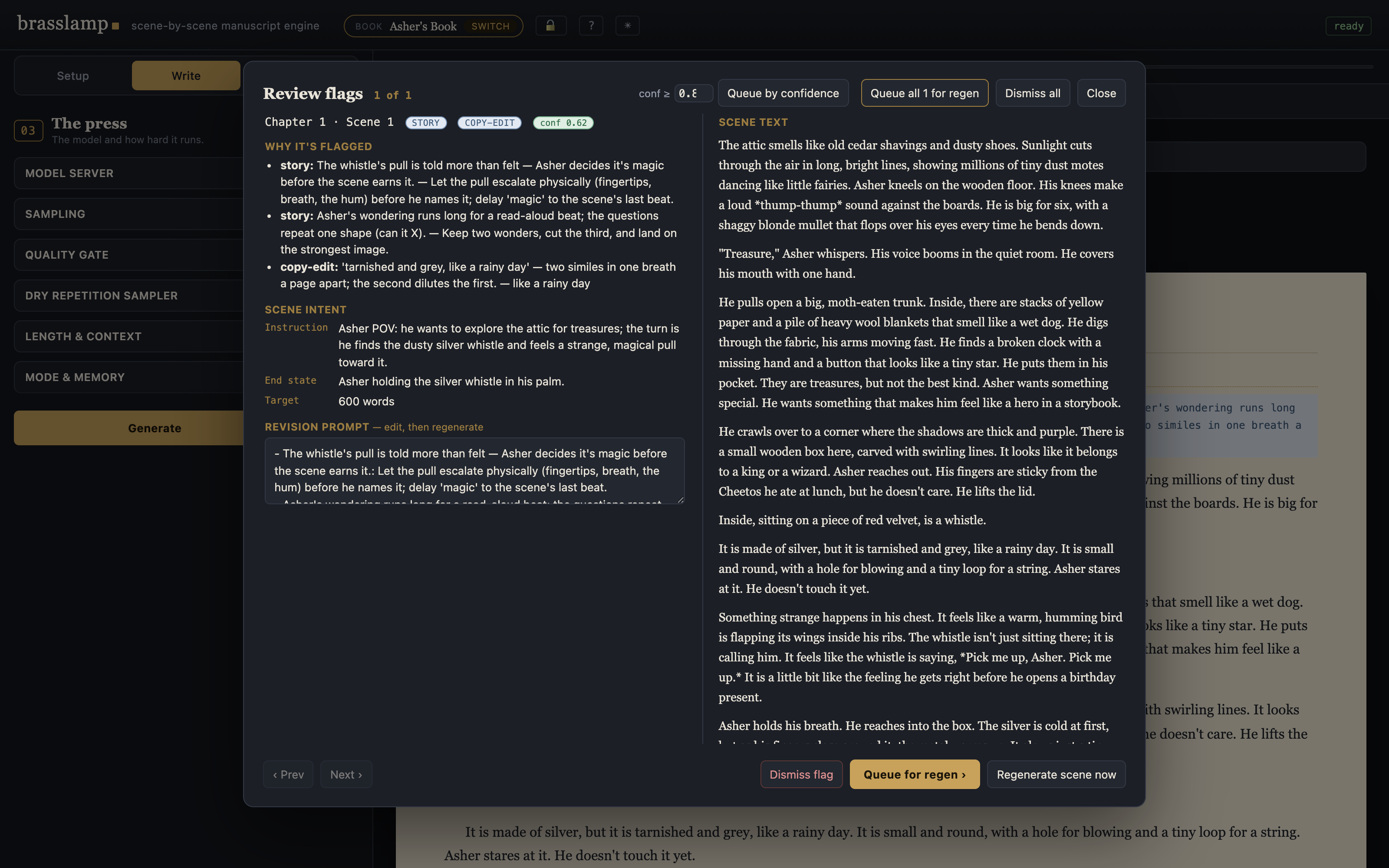
Story-check, copy-edit, continuity, spellcheck, smooth, beta readers — each writes a new version; every old one stays.
One flag queue
Every pass reports to the same place. Verified fixes apply in one click; the rest wait for your judgment.
Regenerate
A paragraph, a scene, or a whole chapter — accepted changes splice in; remaining flags re-anchor to the new text.
Autopilot
The whole chain unattended, ending with a report of what it did and what it left for you.
The story wiki
People, places, and facts harvested from the finished pages — which then ground everything above on the next pass.
Out the door
EPUB, PDF, DOCX, an audiobook-ready export, character cards, a marketing kit.
3 · finish
The part most tools don't have
A finished draft isn't a finished book. This is the studio's deepest layer: a set of passes, each of which writes a new version of the manuscript — the tip moves forward, and every earlier version stays in the timeline.
Continuity check
Flags scene pairs that repeat the same beat when they share actual wording; meaning-only “rhymes” go in a report instead of your task list. Plus pacing and shape analysis, and an optional AI contradiction judge.
Story-check
A developmental audit of the whole book against the bible. Are the characters on-model? Are the world's rules being honored? Do stakes escalate? Is every must-hit event actually in the book — verified by semantic coverage, so a scene that lands across a chapter boundary still counts? Findings land as flags on the manuscript, and every re-run opens with resolved / persisting / new against the last audit, so you can watch the book converge.
Fixes at the right altitude
Three repair modes per scene: a touch-up, a rework that keeps what
happens but rebuilds how it plays, or a fresh re-roll. A whole chapter can be regenerated
with a boundary lock that pins its exits so the rest of the book still fits. An AI
verification confirms the requested change actually landed, and every proposed rewrite
arrives as a word-level red/green diff before you accept it. And some
findings shouldn't be fixed at scene altitude at all — structural complaints route up to
the planning documents instead of being patched in place.
Copy-edit with receipts
Mechanical corrections plus a running style sheet. Every section is deterministically verified against the original; a damaged or truncated section keeps your text — worst case is no change. Change counts are measured, not self-reported by the model. Near-certain fixes are auto-applied under strict guardrails with a full audit list; judgment calls are flagged with confidence scores, which are evidence to weigh, not a grade. One click applies every suggested fix that still verifies verbatim against your text — you review a diff, not two hundred dialogs — and AI-style phrasing rolls up to one flag per scene instead of one per occurrence.
Smooth, spellcheck, narration-clean
Transition smoothing between scenes; a deterministic dictionary spellcheck that learns your book's invented names; a pass that prepares the prose for audio narration.
Guide-check
Edited your writing guide after generating? This pass audits the prose against the guide as it stands now and flags only real rule violations, quoting each one. Only useful if the guide changed — it says so itself.
Beta readers
Five simulated readers — the devourer, the skeptic, the craft reader among them — each read the whole book in character and write you a letter: where they were pulled in, where they nearly quit, what they'd tell a friend. Add your own personas. Sold as what it is: one modeled taste per letter, not a verdict. And a letter isn't the end of the conversation: sit down with the reader and talk about it — they hold their taste under pushback, so you argue, or mine them for specifics — then carry the conversation straight into edits.
Refine: letters become a repair plan
Hand all the reader feedback — the letters, and the flags distilled from them — to the model in one sitting. It groups the many complaints into the few root causes that explain them, names which planning document owns each — bible, outline, or writing guide — and proposes the full set of edits as one plan you confirm before anything is touched. Then the already-written chapters those changes affect are offered for regeneration, one at a time, boundaries held.
⚡ Autopilot
One button runs the recommended chain unattended: diagnose, fix the top flagged scenes with verification, re-audit, polish, proof. Every step writes a new version. It ends with a report of everything it did and the judgment calls it left for you. Close the laptop; reattach later.
All of it converges on one place: the flag system. Every pass writes to a single review overlay, and you walk the flags one at a time — context shown, fix note prefilled, regenerate, accept, or undo. Nothing is auto-accepted without either you or an explicit, guardrailed policy you turned on.
the desk's other chair
Talk to your cast
Every character in the story wiki can be interviewed in a live chat — you type, they answer in real time, as themselves, grounded in the scenes they actually lived. They know their own secrets and guard them: deflect, half-answer, lie, go quiet — until you earn it. It's the fastest way to find a voice, test a motive, or discover what a character thinks happened in chapter twelve.
Pick several and the chat becomes a group scene: the whole room answers in distinct voices, nobody knows another's secrets unless the story says so, and they react to each other — disagreement, interruption, old grudges — not just to you. Conversations are ephemeral by default; flip one toggle and a thread is kept with the book, waiting where you left it.
4 · publish
Out of the studio, into the world
EPUB export is built in, no installs. PDF and DOCX are one-click optional installs. There's a purpose-built audiobook profile — an EPUB prepared for TTS pipelines, with stat blocks made speakable, abbreviations expanded, a pronunciation lexicon, and clean chapter segmentation. And when you need a cover, brasslamp generates three distinct cover-art prompt concepts, ready to paste into any image tool you like. A marketing kit writes the hook, taglines, blurbs, spoiler-labeled synopsis, and keyword set from the book itself. And the cast can leave the book entirely: export any character as a SillyTavern card with a lorebook built from your bible and wiki.
The manuscript's full version archive comes along for the ride — every pass, every draft, non-destructively revertible.
the other door in
Start from a manuscript
Paste an existing manuscript — brasslamp recognizes real-world conventions (CHAPTER ONE,
Ch. 3 — The Door, * * *, §, ———), shows you the
structure it detected, and asks you to confirm it before doing anything. Your original is
never touched.
From the confirmed structure it derives the whole studio: a normalized manuscript; a scene outline with per-scene exits and measured lengths; a story bible with the voice sample quoted verbatim from your own prose; a writing guide; and the full editing state. Every pass above — autopilot included — now works on a book it never wrote. The derived documents are labeled as approximations of your intent, and you can revise any of them through the same guided chats.
There's a further move for heavy revisions: harvest the story wiki — a living encyclopedia of characters, places, items, factions, and lore, every fact tagged with the scene that established it — curate it, lock what's true, then feed it back as hard canon and regenerate the book. The rewrite already knows where everything is going. The wiki will even find pages that are secretly the same entity (“The Warden” and “Kellan Vayne”), confirm the match, and offer — never perform — the merge.
Writing a series? Curated book wikis merge into one series canon, so book three can't contradict book one, cross-book repeats get caught (“this scene reads like book two's set-piece”), and one voice carries across all of it.
What you bring
Honesty up front, because the audiences this is built for consider it a feature: brasslamp does not include an AI model. You point it at any OpenAI-compatible endpoint — a local server like koboldcpp or LM Studio running a model you chose, or a cloud provider with your own API key. A separate, small embeddings model is supported for the semantic features. The prose can only be as good as the model you bring; everything above is about making the most of it, verifiably.
Not sure which model? The EQ-Bench creative-writing leaderboard ranks models by prose quality (sort by size, and prefer a low slop score — the same tells brasslamp's gate enforces), and the UGI leaderboard covers the small community finetunes. A well-ranked 24B beats a mediocre 70B for fiction. And once you're writing, brasslamp's own retry rate is the truest benchmark: if the gate keeps sending scenes back, the model is the bottleneck — it will tell you so.